Showing posts with label Fish. Show all posts

Tuesday, February 5, 2013

Bottlenose Dolphin


Animal You | Bottlenose Dolphin | Tursiope are known to hybridize with other species of dolphins. Hybrids with Risso's dolphin, both in the wild and in captivity. The most famous is the Wolphin, a false killer whale-bottlenose dolphin hybrid. The first was born in 1985 to a female bottlenose dolphin. Hybridized in captivity a dolphin and a rough toothed dolphin. A common dolphin bottlenose dolphin hybrid born in captivity lives at SeaWorld California. Other hybrids live in captivity around the world and in nature, like a dolphin bottlenose dolphin Atlantic spotted hybrid They are gray, varying from. Adults vary in length between 2 and 4 meters (6.6 to 13 m) and weighing between 150 and 650 kg (330 and 1,400 lb) males on average slightly longer and considerably heavier than females. Except in the eastern Pacific tend dolphins in warmer, shallow waters to be less in the colder waters pelagic. A survey in the Moray Firth in Scotland, northern dolphin second world population, recorded an average length of adults less than 4 m (13 ft), compared with a 2.5 m (8.2 ft) with an average population of the coast of Florida.


Bottlenose dolphins can live for over 40 years. Discovered a dolphin in Japan has two additional pectoral fins, or "hind legs", the tail, the size of a pair of human hands. The dolphin in search of food is a form of sonar known as echolocation helped: in search of objects from the sounds they produce and listen to the echoes. Emits a pulse burst of broadband clicking sounds in a focused beam in front of the dolphin. Since the object of interest is approached, the echo mount stronger, and dolphins by reducing the intensity of the sound radiated. Inter-click interval also reduces the animal approaches the target. Apparently the dolphin waits for each echo before clicking on it again. Dolphins have sharp eyes. Bottlenose dolphins are able to salty, sweet, bitter (quinine sulfate) and acid (citric acid), the discovery of taste, but this is not well studied. It is said that some animals in captivity is said to have preferences for fish food, but it is unclear whether this porpoises taste preference mediated burst pulsed sounds, whistles, and body language to communicate. Examples of body language to jump out of the water, grabbed his jaw hit the tail on the surface and the heads of detonation. Sounds and gestures help to pursue other dolphins in the group, and warn other dolphins to danger and nearby food. Every animal has a unique identifier, frequency-modulated narrow-band signature vocalization (signature whistle).


Researchers from the Bottlenose Dolphin Research Institute (BDRI) have in Sardinia (Italy) is now shown whistles and burst pulsed sounds are important animals of social life and mirror their behavior. The Dolphins transmitted these strident sounds when in the presence of other people in the same direction of the prey. Other communication uses about 30 distinguishable sounds, and although famous proposed by John Lilly in 1950, not "dolphin language" was found. The rocker has a single blowhole on the dorsal surface of the head is constituted by a hole, and a muscular valve. Dolphins are breathing volunteers, the area aware and open their holes for air to reach. You can use almost twice as much oxygen in proportion to their body weight than a person can: Dolphin 36 ml of oxygen per kilogram of body weight saving compared to 20 ml / kg for humans Dolphins can breathe while "asleep". The active processes in the brain, on the surface and respiratory behavior. During the sleep cycle, remain near the surface swimming slowly or "logging", and occasionally turning a blind eye.


Women. The breeding season produces significant physiological changes in men. If fewer sperm per mating season out social means wasting less. Males have large testes in relation to body size. During the mating season, the men compete for access to females. Fight other males or females hats for access by other males in Shark Bay, male dolphins have been observed to follow in pairs or larger groups, and / or the movement of a woman in a week waiting period, you become sexually receptive. Mating occurs belly to belly. Georgetown University professor Janet Mann argues the strong personal behavior of male calves is about bond formation and benefits the species in an evolutionary context. Dolphins adult women and young people generally in groups of up to 15 animals, but they live in fission-fusion societies of varying group size change where groups of people, often on a daily or hourly basis. In a community of dolphins near Sarasota, are the most common group for adults. Females with their children, the elderly recent sub-adults of both sexes and adult males alone or in pairs linked Smaller groups can combine large groups of 100 or more to form, and sometimes more than 1000. Social strategies of marine mammals, such as dolphins "interesting parallels" with the social strategies of elephants and chimpanzees.
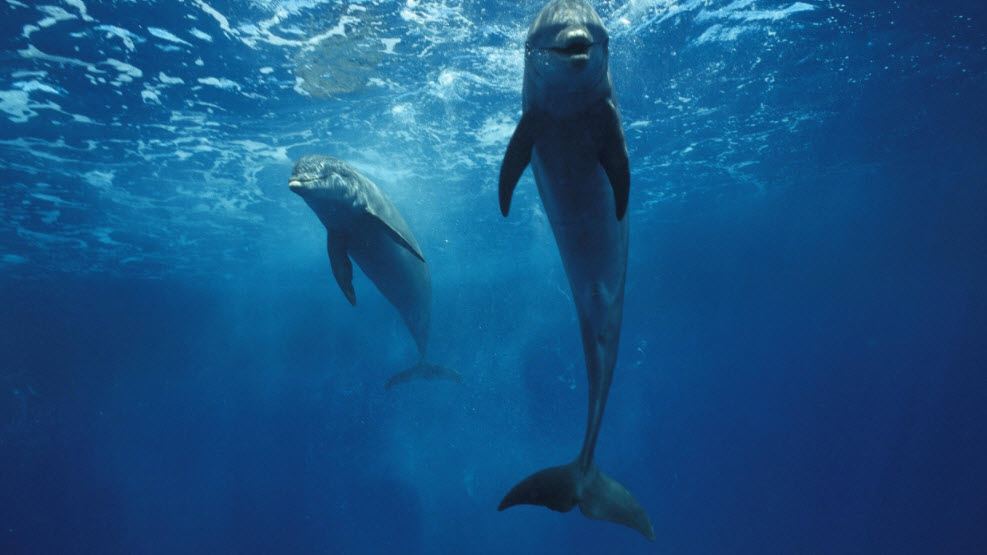

Porpoise by Bottlenose Dolphin Research Institute researchers off the island of Sardinia show random social behavior studied while feeding, and their social behavior is not dependent on food. The diet consists mainly of small fish, crustaceans and squid. The bottlenose dolphin sometimes hits a fish with its fluke, sometimes knocking out water, using a strategy called "fish whacking". If a school to a school of fish, which will tour the school and catch fish in a mini whirlpool Dan if dolphins in the school to be and push their bodies into a mud-flat, so that the fish flat on the mud as well. dolphins then crawling on their side, the consumption of fish washed on the shore. This behavior is due to a small community of bottlenose dolphins over grassland surface run (less than 1 m), in the Florida Keys. Bottlenose dolphins conflict with small-scale coastal fishing business in some areas of the Mediterranean. Common bottlenose dolphins are probably attracted to fishing nets because they offer a concentrated source of food. Dolphins exhibit altruistic behavior toward other sea creatures. On Mahia Beach, New Zealand, March 10, 2008, two pygmy sperm whales, one female and calf, stranded on the beach. The bottlenose dolphin can behave aggressively. Men fight for rank and access to females. Researchers at the University of Aberdeen say the dolphins do not eat their victims, but only in competition for food.


The bottlenose dolphin sometimes forms mixed species groups with other species of the dolphin family, particularly larger species, such as short-finned pilot whales, killer whales and Risso's dolphins. They also interact with smaller species, such as Atlantic Spotted Dolphin and rough toothed dolphin. Some species of large sharks such as the tiger and the white shark, the great white shark and the bull shark, prey on the bottlenose dolphin, especially calves. The dolphin is able to defend itself by charging the predator behavior 'bullying' dolphin sharks can sometimes be fatal for the shark Towards a single adult dolphin can be dangerous for a shark of similar size. . Orca populations in New Zealand and Peru have been observed to hunt dolphins, but this seems rare, and other orcas may swim with the dolphins. Swimming in Dolphins defend themselves from predators. Bottlenose dolphins and complex evasive strategies to their enemies, or bullying techniques Outswim forced predator fight to the death or escape. The species has sometimes curiosity towards humans or near water. In November 2004, a dramatic report of dolphin intervention from New Zealand. In coastal regions, dolphins run the risk of collisions with boats. The researchers of the period of research work bottlenose first Institute of quantified data in solitary bottlenose dolphin diving behavior in the presence and absence of boats. Dolphins responded tourism than fishing. Driving speed, engine type and distance all affect dolphin safety.


Bottlenose dolphins perform in many aquaria, generating much controversy. Some animal rights activists say the dolphins do not have enough space or adequate care or stimulation. But others counter that the dolphins are well cared for and enjoy interacting with people. Eight dolphins inhabiting the Marine Life Aquarium in Gulfport, Mississippi were swept away from their aquarium pool during Hurricane Katrina. Therapy for children with disabilities are able to interact with the dolphins. The military of the United States and Russia train bottlenose dolphins. "Dolphin Encounter" commercial and tour in many countries. In the town of Laguna in south Brazil, a pod of dolphins fish for anglers of driving on the beach in shallow water. A dolphin then continues, after which the fishermen cast their nets. The dolphins feed on fish in flight.
Find Animal You
READ MORE - Bottlenose Dolphin

Tuesday, January 29, 2013

Sand Tiger Shark


Animal You | Sand Tiger Shark | The eyes of the sand tiger shark are small caps, lost, one of the many functions of the shark. The sand tiger shark swim mostly with open mouth showing three rows high. Smooth edges and sharp teeth Adult sharks tend to be scattered red-brown spots all over the body. Minor sand tiger sharks have yellow-brown spots on his body. The sand tiger shark has a gray back and white belly. Males have claspers gray. The sand tiger length in average transit time of 1.9 to 1.95 m (6.2 to 6.4 feet) in men and 2.2 m (7.2 ft) in women, with the latter sex the larger body. Large adult specimens can reach a length of 3.0 to 3.4 m (9.8 to 11.2 feet). Sand tiger sharks are a maximum weight of 159 kg (350 lb) presented achieve, but some sources say try, to a weight of 300 kg (660 lb) away. The sand tiger shark is an active investor night. The sand tiger shark has been observed in the hunt groups meet with other sand tiger sharks, if they take advantage of large schools of fish. The sand tiger met in numbers when hunting large prey, or clutch. If the shark matures, tend to eat larger prey, like other sharks, dolphins and swordfish. The sand tiger is often caught from eating fish, sharks, rays, crabs and small bluefin tuna in nets. The sand tiger hunt. There are only a few examples of unprovoked shark attacks sand tiger in humans. If aggressive sharks tend to steal bait or fish instead of attacking people.


Sand tiger sharks roam epipelagic and mesopelagic regions of the ocean, sandy shores, estuaries, shallow bays and rocky or tropical reefs, in depths up to 19 meters (62 feet). However, sand tiger sharks inhabit deeper waters covered. Sand tiger sharks have been seen in Canadian waters three times: in the Minas Basin of Nova Scotia, near St. Andrews, New Brunswick, and the time for Lepreau, New Brunswick. The sand tiger shark can in the Atlantic, Pacific and Indian Oceans and are found in the Mediterranean and the Adriatic. In the western Atlantic, sand tiger sharks in the coastal waters of the Gulf of Maine to Florida, in the northern Gulf of Mexico around the Bahamas and Bermuda, and from southern Brazil to northern Argentina. The sand tiger shark is also found in the eastern Atlantic, from the Mediterranean to the Canary Islands, Cape Verde Islands, along the coast of Senegal and Ghana, Cameroon and southern Nigeria. The sand tiger shark has been observed in the Red Sea and is located east to India.


During mating the male grips the female sand tiger fins with teeth. The male sharks use claspers (modified pelvic fins) inseminate the female. The sand tiger shark has one of the lowest playing all kinds of sharks. They shall be easily influenced by the demographic pressure Female sharks have two uterus. After a long work, the female gives birth to 1 meter (3 feet) long descent, totally independent. According to the National Marine Fisheries Service, any shark caught immediately be released with minimal damage, and is regarded as a prohibited species, making it illegal to be a part of the sand tiger shark on the Atlantic coast of the United. The sand tiger population is less than 20 percent in the last ten years, which means that the shark is vulnerable by the World Conservation Union. To decrease the population of tigers sand Sand Tigers can be caught by fishing trawlers, although often caught with a fishing line. Fins sand tiger "is a popular topic in the Japanese market. Shark liver oil is a popular product in beauty products such as lipstick.


Northern Australia, their networks rather than float protect sharks. Many sand Tiger caught in the nets and then strangled or fishermen. Estuaries along the United States of America, the Atlantic coast is home to many of the young sand tiger sharks. Because the sand tiger sales worldwide has many common names. gray nurse shark, the name in Australia and the UK is the second most common name for the shark. Other names that chipped tooth (South Africa), and blue-nurse sand tiger (India) have discovered 

Find Animal You
READ MORE - Sand Tiger Shark

Sunday, January 27, 2013

Salmon


Animal You | Salmon | Salmon eggs are set in the freshwater streams typically at high latitudes. The eggs hatch into fry or fry ends. Only 10% of salmon eggs survive estimated at this stage. Changes in smolt body chemistry, allowing them to live in salt water. The salmon spend one to five years (depending on species) in the ocean, where little by little pubescent. The adult salmon then return everything to their natal streams to spawn. Just prior to spawning, depending on the species, salmon changes. You can develop a hump, develop canine teeth develop kype (a curve from the jaws of the male salmon). Everything will change the silvery blue of a fresh sea fish within a darker color. Salmon make amazing journeys, sometimes moving hundreds of miles upstream against strong currents and rapids to reproduce. Chinook and sockeye salmon from central Idaho, for example, traveling more than 900 miles (1,400 km) and climb nearly 7,000 feet (2,100 m) in the Pacific to return to spawn.


Between 2 and 4% of Atlantic salmon scavengers survive to breed again, all women. But even in those species of salmon that may survive more than once (iteroparity) spawn after spawning mortality is quite high (perhaps as high as 40-50%.) To make the eggs, the female salmon uses her tail (caudal fin), to create a low pressure zone, lifting gravel to be swept down, digging a shallow depression, called REDD. The eggs generally orange to red. Fresh water growth rings shows that the tight against the growth of sea spaced rings; spawn is characterized by considerable erosion as body mass becomes eggs and spleen. Freshwater streams and estuaries provide important habitat for many species of salmon. Mortality of salmon in the early life stages is usually high due to natural predation and human-induced changes in habitat, such as salinity, high water temperatures, the oxygen concentration is low, the high and low Cover Flow reduced river. Estuaries and associated wetlands provide vital areas for salmon farming before landlocked.


In the Pacific Northwest and Alaska salmon are keystone species, support wildlife, such as birds, bears and otters. The bodies of the salmon is a transfer of nutrients from the ocean, rich in nitrogen, sulfur, carbon and phosphorus in forest ecosystems. Function grizzly ecosystem engineers, salmon catch and bring in adjacent wooded areas. Fir leaf up to 500 m (1,600 ft) of a stream where bears are fishing for salmon in nitrogen salmon fishing. More information: Salmon Run. It was recorded in the field samples of salmon returning to the islands of the Queen Charlotte Islands. Henneguya myxosporean parasites and other group a complex life cycle, where the salmon is one of the two hosts. Fish provides the spores after spawning. If Henneguya, spores of introducing a second host, an invertebrate probably in spawning stream. When juvenile salmon migrate to the Pacific Ocean, the second host gives a platform for infectious salmon. The parasite is then introduced into the salmon farming cycle to the next.


According to Klaus Schallie, crustacean Program Specialist Food Inspection Agency of Canada, "nicola salmi Henneguya located in southern BC also and in all species of salmon. Many farms can create net densely populated in unusually high concentrations of sea lice, when exposed in estuaries with large number of open net farms, many young wild salmon are infected and do not survive longer. Adult salmon may survive otherwise critical numbers of sea lice, but small, thin-skinned juvenile salmon migrating to sea are highly vulnerable. On the Pacific coast of Canada, the louse-induced mortality of pink salmon in some regions is generally over 80%. Salmon is a popular food. Classified as an oily fish, salmon is considered healthy by high protein fish rich in omega-3 fatty acids and vitamin D. Salmon is high also a source of cholesterol, with a range of 23-214 mg/100 g, depending on the species. According to reports in the journal Science, but farmed salmon may contain high levels of dioxins. PCBs (polychlorinated biphenyls) levels may be up to eight times higher in farmed salmon than in wild salmon.


Salmon flesh is generally orange to red, with white meat, although the product of wild salmon. The natural color of the carotenoid pigments, mainly salmon astaxanthin, canthaxanthin, but also in salmon flesh.Wild obtain these carotenoids by eating krill and other small crustaceans. The vast majority of Atlantic salmon in the world are high (almost 99%), whereas the majority of Pacific salmon are wild caught (over 80%). Canned salmon in the U.S. is usually taken wild Pacific, although some farmed salmon is available as canned. Smoked salmon is another popular preparation method, and can be hot or cold smoked. Lox can refer to cold smoked salmon or smoked salmon in a brine solution (also called gravlax). Traditional canned salmon includes some skin (which is harmless) and bone (which adds calcium). Canned salmon skinless and boneless is also available. Raw salmon flesh may Anisakis nematodes, marine parasites that cause anisakiasis. Check the availability of refrigeration, the Japanese did not consume raw salmon. Salmon and salmon caviar comes only in making sashimi (raw fish) and sushi

Find Animal You
READ MORE - Salmon

Sunday, December 16, 2012

Flying Fish


Animal You | Flying fish | Hawk live in all oceans, primarily in tropical and subtropical warm waters. Its most notable feature is their pectoral fins, which are not large, and allow the fish to hide and escape from predators, leaping out of the water and fly through the air a few feet above the water surface. Slide upward water, a flying fish moves its tail up to 70 times per second. It spreads its pectoral fins and tilts slightly upward to support. Fish is to increase their time in the air flying straight or at an angle to the direction of air currents created by a combination of air waves and sea.From 1900-1930, flying fish studied as potential models used to construct the plane. Predators include dolphins, tuna, marlin, birds, squids and porpoises.


Creature spent 45 seconds in flight. Flying fish are commercially fished in Japan, Vietnam and China through gillnets, and Indonesia and India for dipnetting. In Japanese cuisine, the fish are often preserved by drying. Kite is part of the national dish of Barbados, known as cou-cou and flying fish. Historically, Barbados has been called "the land of the flying fish", which is now the official national fish Once abundant, migrated between the warm coral-filled Atlantic Ocean surrounding the islands of Barbados and plankton-rich outflows of the Orinoco River in Venezuela.


Only after the completion of the port of Bridgetown / deepwater port in Bridgetown, Barbados saw an increase of ship visits, which connects the island with the world. Moreover, Barbados overfishing pushed them closer to the Orinoco River delta, no longer returning to Barbados in large numbers. Today, the only hawk migrate north to Tobago, about 120 nautical miles (220 km, 140 miles) south-west of Barbados. Despite the changes, flying fish remain a coveted delicacy.


Moreover, performances and actual hologram flying fish also in the passport of Barbados. Lately, the flying fish are also gaining popularity in other islands, fueling several maritime disputes. In 2006, the Council of the United Nations Convention on the Law of the Sea establishes the boundary between Barbados and Trinidad and Tobago for the flying fish dispute, which gradually increased tensions between the neighbors. Fishermen still southern Barbados flying fish.  

Find Animal You
READ MORE - Flying Fish

Thursday, November 15, 2012

Bull Shark


Animal You | Bull Shark | The bull shark is generally warm global coastal waters, rivers and lakes, rivers and salt and fresh water from time to time, if they are deep enough. Populations of bull sharks are also several major rivers, with more than 500 bull sharks probably live in the Brisbane River. A large bull shark was caught in the canals of Scarborough, two hours north of the Gold Coast. The shark has traveled 4,000 kilometers (2,500 miles) from the Amazon to Iquitos, Peru. The bull shark is generally fertile in the warm waters and coastal estuaries of the Mozambique Channel and south, including KwaZulu-Natal and Mozambique.


After Hurricane Katrina, many bull sharks were spotted in Lake Pontchartrain. Bull sharks sometimes spent the Mississippi River in Alton, Illinois. The bull shark is the best of 43 species of elasmobranch in ten genera and four families have been reported in freshwater. Some breeds (Rajidae), smooth dogfish (Triakidae) and gray reef sharks (Carcharhinus plumbeus) regularly enter estuaries.


This leads to a large flow of water through the gills osmosis and loss of body sodium and shark chloride. however, freshwater bull sharks in possession of several organs, which are suitable for the conservation of the balance of salt and water, rectal gland, kidney, liver and gills. elasmobranch rectal gland Any of the excretion of excess salt works living in sea water accumulated. freshwater bull sharks reduced the sodium chloride urinary rectal gland activity retained.


At first, scientists thought the sharks in Lake Nicaragua belonged to an endemic species, the Lake Nicaragua shark (Carcharhinus nicaraguensis). A bull shark feeding consists mainly of bony fish and sharks as the bull shark, on the other hand, but also turtles, birds, dolphins, terrestrial mammals, crustaceans, echinoderms and races. Bull sharks have been known to use the technique of strikes and bites its prey. Bull sharks are usually solitary hunters, but sometimes hunt in pairs. Often cruise the shallow waters.


One or more bull sharks may be responsible for shark attacks Jersey Shore in 1916, which is the source of inspiration for Peter Benchley Shark new. Speculation bull sharks can charge on the basis of a series of attacks that occur in fresh and brackish water, and there are similarities in bite marks between bull and great white sharks. The bull shark is responsible for attacks across the entrance to Sydney Harbour. Most of these attacks were previously attributed to great white shark. In India, the bull shark attacked swim along the corridor and people. Many of these attacks were the Ganges shark, Glyphis gangeticus, a species endangered river shark shark probably the only one in India, claimed to be able to survive in fresh water, although the gray nurse shark was also accused in the sixties and seventies. Bull sharks mate in late summer and early autumn, often in the brackish water of river mouths. After 12 months of pregnancy, a bull shark give birth to young 10:04.
Find Animal You
READ MORE - Bull Shark